Ambiguity → the wrong system
Informal requirements read differently to different engineers. "Fast", "shortly after", "stable" — each reader fills the gap their own way, and a correct implementation of a misread requirement is still the wrong system.
What if your computer could understand your requirements?
After the enable signal, the brake command shall settle within a short time.
Two gaps sit between a written requirement and a safe system. Both stay open no matter how many tests you run.
Informal requirements read differently to different engineers. "Fast", "shortly after", "stable" — each reader fills the gap their own way, and a correct implementation of a misread requirement is still the wrong system.
Testing checks the behaviors you thought to try. It can't cover every input, state and calibration, so the real question — "can my safety requirement ever be violated?" — stays open after the suite goes green.
Testing is sampling. Formal verification is proof.
Formal methods close both gaps: make the requirement precise, then prove the code against it.
BTC Universal Pattern is a graphical, intuitive method for requirements engineering — the editor and the documentation are the same artifact. You describe what must hold; the tool makes it machine-readable, and traceability to the source requirement is preserved throughout.
Highlight the meaningful phrases in the requirement and turn them into reusable macros.
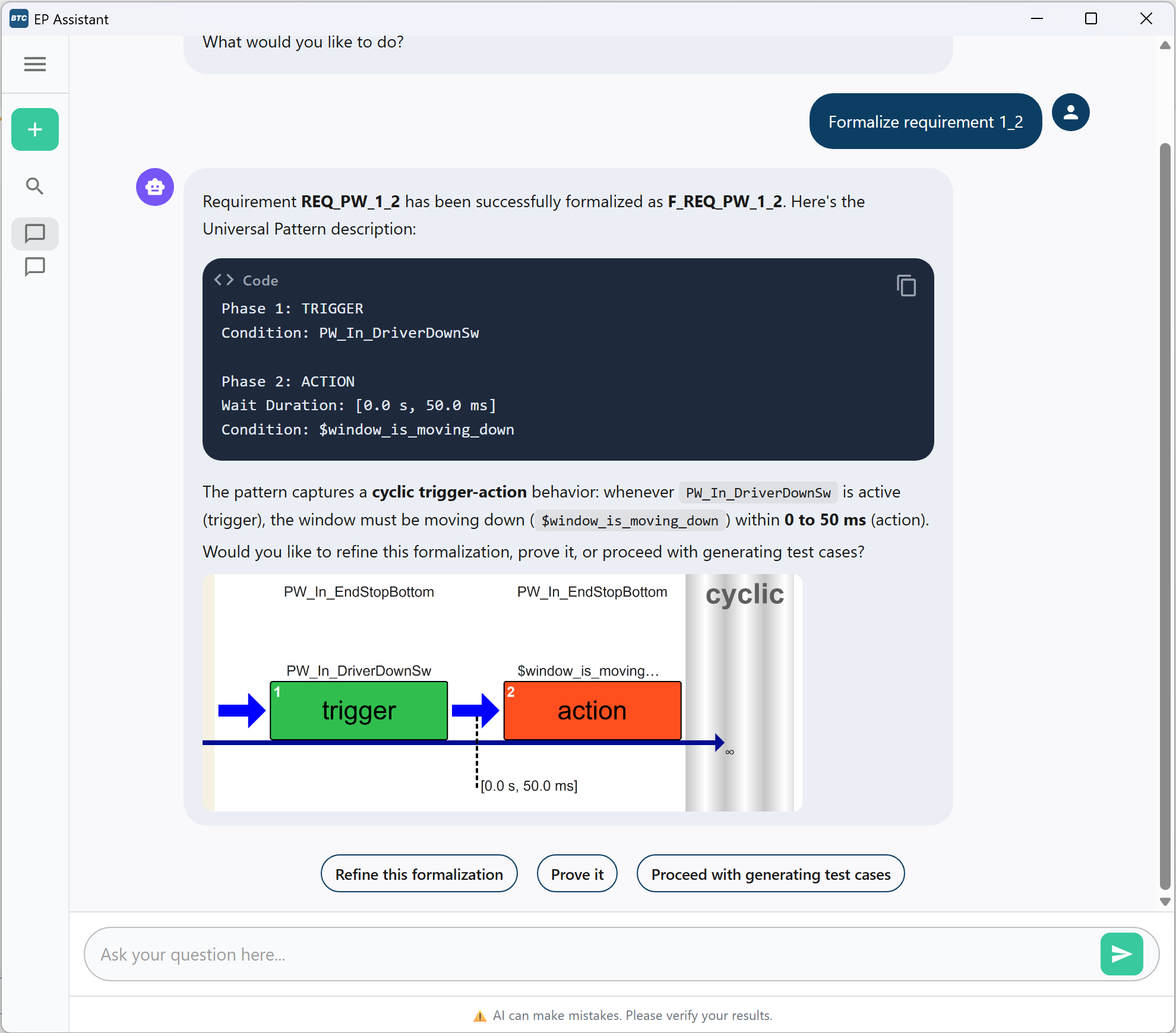
Place the macros graphically as trigger, action and timing — the pattern removes the ambiguity.
Bind each macro to real system signals. The requirement is now machine-readable and executable.
Writing formal specifications by hand was a challenge. Formalizing a requirement is fundamentally a language task — which is exactly what modern AI is good at.
The BTC AI Assistant drafts a Universal Pattern from a written requirement — trigger, action and timing — ready for you to refine, approve, or generate test cases from.
Machine-readable requirements = automated verification.
Cross-checks every existing test case against every formalized requirement at once — catching side effects a test was never written to look for, with no extra effort.
Model checking generates the exact test cases missing from your suite, driving requirements coverage to 100% — deterministically, not by trial and error.
Model checking produces a mathematical proof that a requirement can never be violated — no input or calibration combination reaches the unsafe state — or returns a concrete counter-example.
Formalizing forces precision — vague requirements are caught before code and tests exist.
Requirements coverage measured and closed automatically, not estimated.
Every test checked against every requirement — regressions surface with zero extra effort.
Auto-generated vectors close the gaps to full requirements coverage.
A guarantee over all inputs and calibrations.
An evaluation license includes a launch workshop with our engineers — set up on one of your real requirements, end to end.